---
title: "The Smoking Gun: Using Photo Proof to Win \"Unwinnable\" Payment Disputes"
description: Stop losing summer revenue to payment disputes. Learn how tour operators use photo proof to win friendly fraud cases and protect their bottom line.
image: https://www.fotaflo.com/hubfs/smoking%20gun%20chargebacks.png
---
[Skip to content](https://www.fotaflo.com/blog/fight-friendly-fraud-tour-operators-guide#main-content)
[](https://www.fotaflo.com/)
- By Role
### Built for the people who shape every guest experience.
From owners to guides, Fotaflo helps your team capture memories, save time, and keep guests talking long after the tour ends.
[Guides & Photographers](https://www.fotaflo.com/by-role/tour-guides) [Operations](https://www.fotaflo.com/by-role/operations-manager) [Marketing](https://www.fotaflo.com/by-role/marketing-manager) [Revenue Generation](https://www.fotaflo.com/by-role/revenue-generation) [Owners & General Managers](https://www.fotaflo.com/by-role/tour-operator-owner)
Looking for your role?
Explore how Fotaflo supports each part of your team, from operations to guest-facing staff.
[Book a Demo](https://www.fotaflo.com/book-a-demo)
- By Industry
### Built for experience operators who want more guests.
Boat tours, escape rooms, and beyond. Fotaflo helps turn guest memories into more reviews, referrals, and repeat bookings.
[Boat Tours](https://www.fotaflo.com/by-industry/boat-tour-photo-management-software) [Zipline & Canopy Tours](https://www.fotaflo.com/by-industry/zipline-photo-software) [Attractions](https://www.fotaflo.com/by-industry/digital-souvenir-photo-platform) [Watersport Operators](https://www.fotaflo.com/by-industry/watersports-photo-delivery-software) [Escape Rooms](https://www.fotaflo.com/by-industry/escape-room-photo-software) [Animal Experiences](https://www.fotaflo.com/by-industry/experiential-tour-photo-marketing-platform) [City & Food Tours](https://www.fotaflo.com/by-industry/food-tour-guide-photo-app) [Horseback Riding Experiences](https://www.fotaflo.com/by-industry/trail-ride-photo-software)
Not seeing your business?
If you run an experience business, there is a strong chance Fotaflo fits. Book a demo to learn more.
[Book a Demo](https://www.fotaflo.com/book-a-demo)
- [Integrations](https://www.fotaflo.com/integrations)
- Resources
### Advice and tools for operators who want to grow smarter.
Browse practical guides, customer stories, and memory marketing ideas built for busy experience teams.
[Testimonials](https://www.fotaflo.com/testimonials) [Features](https://www.fotaflo.com/features) [Downloads, guides, and more](https://www.fotaflo.com/ebooks-guides-and-more) [Frequently asked questions](https://www.fotaflo.com/faq) [Blog](https://www.fotaflo.com/blog) [About Fotaflo](https://www.fotaflo.com/about-fotaflo)
Need a starting point?
Start with the resource that matches your next challenge, then put it to work in your business.
[Book a Demo](https://www.fotaflo.com/book-a-demo)
- [Pricing](https://www.fotaflo.com/pricing)
[Sign In](https://app.fotaflo.com/sign-in) [Book a Demo](https://www.fotaflo.com/book-a-demo)
Toggle menu
- By Role
- By Industry
- [Integrations](https://www.fotaflo.com/integrations)
- Resources
- [Pricing](https://www.fotaflo.com/pricing)
## By Role
### Built for the people who shape every guest experience.
From owners to guides, Fotaflo helps your team capture memories, save time, and keep guests talking after the experience ends.
- [Guides & Photographers](https://www.fotaflo.com/by-role/tour-guides)
- [Operations](https://www.fotaflo.com/by-role/operations-manager)
- [Marketing](https://www.fotaflo.com/by-role/marketing-manager)
- [Revenue Generation](https://www.fotaflo.com/by-role/revenue-generation)
- [Owners & General Managers](https://www.fotaflo.com/by-role/tour-operator-owner)
Looking for your role?
Explore how Fotaflo supports each part of your team, from operations to guest-facing staff.
## By Industry
### Built for experience operators who want more guests.
Boat tours, escape rooms, and beyond. Fotaflo helps turn guest memories into more reviews, referrals, and repeat bookings.
- [Boat Tours](https://www.fotaflo.com/by-industry/boat-tour-photo-management-software)
- [Zipline & Canopy Tours](https://www.fotaflo.com/by-industry/zipline-photo-software)
- [Attractions](https://www.fotaflo.com/by-industry/digital-souvenir-photo-platform)
- [Watersport Operators](https://www.fotaflo.com/by-industry/watersports-photo-delivery-software)
- [Escape Rooms](https://www.fotaflo.com/by-industry/escape-room-photo-software)
- [Animal Experiences](https://www.fotaflo.com/by-industry/experiential-tour-photo-marketing-platform)
- [City & Food Tours](https://www.fotaflo.com/by-industry/food-tour-guide-photo-app)
- [Horseback Riding Experiences](https://www.fotaflo.com/by-industry/trail-ride-photo-software)
Not seeing your business?
If you run an experience business, there is a strong chance Fotaflo fits.
## Resources
### Advice and tools for operators who want to grow smarter.
Browse practical guides, customer stories, and memory marketing ideas built for busy experience teams.
- [Testimonials](https://www.fotaflo.com/testimonials)
- [Features](https://www.fotaflo.com/features)
- [Downloads, guides, and more](https://www.fotaflo.com/ebooks-guides-and-more)
- [Frequently asked questions](https://www.fotaflo.com/faq)
- [Blog](https://www.fotaflo.com/blog)
- [About Fotaflo](https://www.fotaflo.com/about-fotaflo)
Need a starting point?
Choose the resource that matches your next challenge and get moving faster.
[Sign In](https://app.fotaflo.com/sign-in) [Book a Demo](https://www.fotaflo.com/book-a-demo)
# The Smoking Gun: Using Photo Proof to Win "Unwinnable" Payment Disputes
May 19, 2026
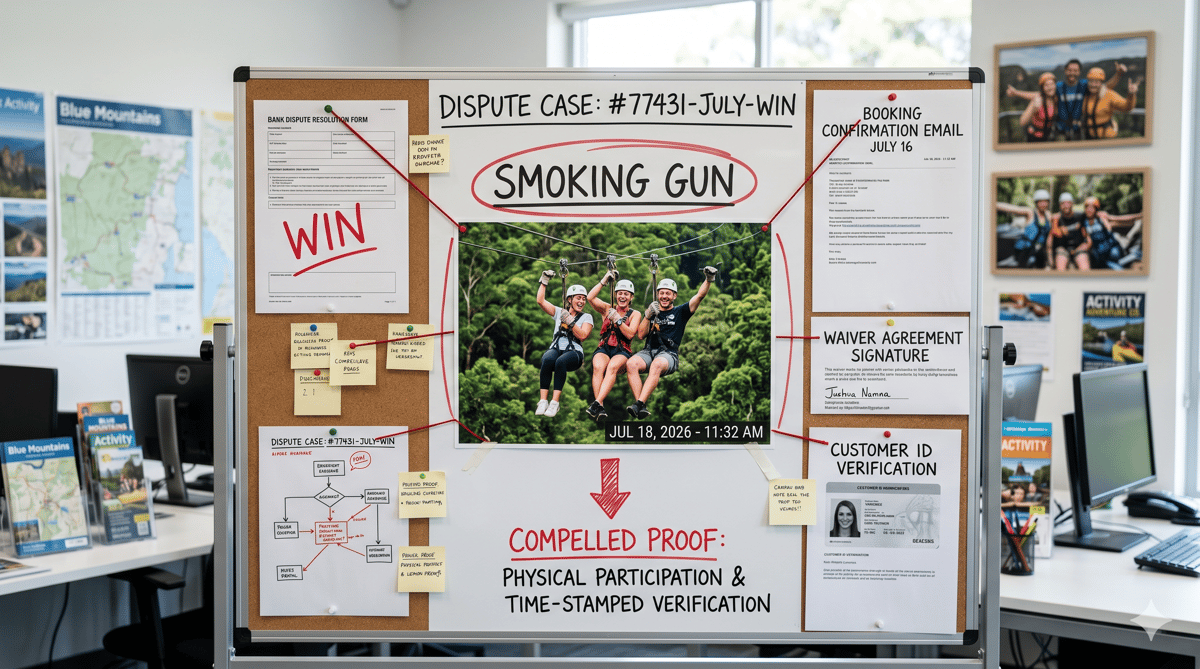
Every tour operator knows the feeling. You’ve just finished a record-breaking weekend. The sun was out, the guests were smiling, and the reviews are starting to roll in. Then, you open your merchant portal and see it: **The Chargeback.**
A guest who was physically on your boat, zipline, or bus just claimed with their bank that they “never received the service” or that the "transaction was unauthorized."
In the industry, we call this **Friendly Fraud.** And in 2026, it’s no longer a minor annoyance—it’s a multi-billion dollar crisis.
### **What is Friendly Fraud?**
Unlike "true fraud" (where a stolen credit card is used), **Friendly Fraud** occurs when a legitimate customer makes a purchase, experiences the service, and then disputes the charge with their bank anyway.
Sometimes it’s accidental—a spouse doesn't recognize the business name on a credit card statement. Other times, it’s intentional—a guest trying to bypass a non-refundable cancellation policy after the fact. Regardless of the intent, the result for the operator is the same: **lost revenue, a hefty dispute fee, and hours of wasted administrative time.**
### **The True Cost: A $3.75 Penalty for Every $1 Lost**
The financial drain of friendly fraud is staggering. According to recent 2025-2026 industry data from Mastercard and LexisNexis:
- **The Travel Tax:** The travel and hospitality sector has the **highest average chargeback value ($120)** of any industry.
- **The Total Drain:** For every **$1.00** lost to a chargeback, the actual cost to the business is approximately **$3.75** once you factor in merchant fees, labor, and the lost cost of the service provided.
- **A Growing Epidemic:** Friendly fraud now accounts for over **75% of all chargebacks** in the travel sector.
### **Why Operators Almost Always Lose**
If you’ve ever tried to fight a dispute, you know the deck is stacked against you. Banks overwhelmingly side with the consumer. To win, an operator must provide **"Compelling Evidence."** The problem? Standard evidence usually isn't enough:
- **Confirmation Emails:** Only prove a booking was made, not that the person showed up.
- **Digital Waivers:** Often challenged by banks as "not proof of service delivery".
- **GPS Logs:** Too technical for most bank representatives to verify easily.
Operators often spend 2–3 hours per dispute gathering paperwork, only to have the bank rule in favor of the guest because there was no "visual proof of participation."
### **The Solution: Fotaflo is Your "Smoking Gun"**
This is where Fotaflo changes the game. While our clients originally bought Fotaflo to automate their memory marketing, they’ve discovered a powerful secondary benefit: **It’s the ultimate dispute-winning machine.**
**How Fotaflo helps you win:**
1. **Visual Proof of Participation:** A timestamped photo of a guest smiling on your tour is the "Compelling Evidence" banks can’t ignore. It proves the guest was physically present and received the service.
2. **Identity Verification:** When a photo is delivered to a guest's specific email or phone number and they *engage* with that photo (open/share), it creates a digital paper trail that links the cardholder directly to the experience.
3. **The "Oh, Right!" Factor:** Many friendly fraud cases are just forgetful guests. When you send a follow-up photo gallery, it serves as a visual receipt, preventing the "I don't recognize this charge" dispute before it ever happens.
### **Protect Your Summer Revenue**
As you gear up for your busiest season, don't let "friendly fraud" eat into your hard-earned profits. It’s time to stop writing off disputes as a "cost of doing business."
With Fotaflo, you aren't just giving your guests a memory—you’re giving your business a shield.
**Stop losing revenue to disputes. [Book a Fotaflo Demo today ](https://www.fotaflo.com/book-a-demo)and see how photo proof can protect your bottom line this summer.**
[Return to Blog](https://www.fotaflo.com/blog)
## Share this post
[mailto:?subject=The+Smoking+Gun%3A+Using+Photo+Proof+to+Win+%26quot%3BUnwinnable%26quot%3B+Payment+Disputes&body=https%3A%2F%2Fwww.fotaflo.com%2Fblog%2Ffight-friendly-fraud-tour-operators-guide](mailto:?subject=The+Smoking+Gun%3A+Using+Photo+Proof+to+Win+%26quot%3BUnwinnable%26quot%3B+Payment+Disputes&body=https%3A%2F%2Fwww.fotaflo.com%2Fblog%2Ffight-friendly-fraud-tour-operators-guide)
Copy link
## Popular Posts
- [How To Generate Reviews Online Through Thank You Videos](https://www.fotaflo.com/blog/how-to-generate-reviews-online-through-thank-you-videos)
- [5 Reasons Why Capturing a Memory is Just as Important as Creating One](https://www.fotaflo.com/blog/5-reasons-why-capturing-a-memory-is-just-as-important-as-creating-one)
- [The Importance of Photo Marketing and the Guest Experience](https://www.fotaflo.com/blog/improve-guest-and-staff-experience-with-your-photo-marketing-service)
- [From hobby to business: How to start a fishing charter with success](https://www.fotaflo.com/blog/how-to-start-a-fishing-charter)
- [Attraction Marketing: Increase Conversions With Intentional Photos](https://www.fotaflo.com/blog/how-to-increase-conversions-with-intentional-photos-attraction-marketing)
- [The most successful marketing to combat the effects of covid-19](https://www.fotaflo.com/blog/how-to-market-your-business-in-the-face-of-covid-19)
## Related posts
July 9, 2026
### [Incoming Trust Crisis: Why Public Feeds Are Dying and Peer-to-Peer Marketing is Winning](https://www.fotaflo.com/blog/peer-to-peer-marketing)
.jpeg?length=900&name=AdobeStock_361612471%20(1).jpeg)
July 9, 2026
### [The 2026 AI Echo Chamber: Why Real Memories Will Outlast the Algorithm](https://www.fotaflo.com/blog/ai-vs-real-memories-experience-marketing)

May 19, 2026
### [3 Immediate Steps to Protect Your Summer Revenue from Payment Disputes](https://www.fotaflo.com/blog/protect-summer-tour-revenue-chargeback-tips)
## Fotaflo monthly newsletter
Subscribe to receive industry updates and the best advice on memory marketing.
## 
## Free eBook
Unlock the Power of Memory Marketing. Discover the secrets to attracting more customers and driving repeat business.
[Download PDF](https://www.fotaflo.com/free-ebook-unlock-the-power-of-memory-marketing)

## By Role
- [Guides & Photographers](https://www.fotaflo.com/by-role/tour-guides)
- [Operations](https://www.fotaflo.com/by-role/operations-manager)
- [Marketing](https://www.fotaflo.com/by-role/marketing-manager)
- [Revenue Generation](https://www.fotaflo.com/by-role/revenue-generation)
- [Owners & General Managers](https://www.fotaflo.com/by-role/tour-operator-owner)
## By Industry
- [Boat Tours](https://www.fotaflo.com/by-industry/boat-tour-photo-management-software)
- [Zipline & Canopy Tours](https://www.fotaflo.com/by-industry/zipline-photo-software)
- [Attractions](https://www.fotaflo.com/by-industry/digital-souvenir-photo-platform)
- [Watersport Operators](https://www.fotaflo.com/by-industry/watersports-photo-delivery-software)
- [Escape Rooms](https://www.fotaflo.com/by-industry/escape-room-photo-software)
- [Animal Experiences](https://www.fotaflo.com/by-industry/experiential-tour-photo-marketing-platform)
- [City & Food Tours](https://www.fotaflo.com/by-industry/food-tour-guide-photo-app)
- [Horseback Riding Experiences](https://www.fotaflo.com/by-industry/trail-ride-photo-software)
## Resources
- [Testimonials](https://www.fotaflo.com/testimonials)
- [Features](https://www.fotaflo.com/features)
- [Downloads, guides, and more](https://www.fotaflo.com/ebooks-guides-and-more)
- [Frequently asked questions](https://www.fotaflo.com/faq)
- [Blog](https://www.fotaflo.com/blog)
- [About Fotaflo](https://www.fotaflo.com/about-fotaflo)
## Quick Links
- [Integrations](https://www.fotaflo.com/integrations)
- [Pricing](https://www.fotaflo.com/pricing)
## Contact Information
**General: **[Contact Us](https://www.fotaflo.com/contact%20us)
**Phone: **[1-855-368-2123](tel:+18553682123)
[](https://cta-redirect.hubspot.com/cta/redirect/4344830/e5c69b6b-7ef2-40bd-9db6-77d69f11e5b3)
Copyright 2026 | [Privacy Policy](https://www.fotaflo.com/legal/customer-privacy-policy-0) | [Legal Stuff](https://www.fotaflo.com/legal-stuff)
```json
{
"@context" : "https://schema.org",
"@type" : "BlogPosting",
"author" : {
"@type" : "Person",
"name" : "Fotaflo",
"url" : "https://www.fotaflo.com/blog/author/fotaflo"
},
"dateModified" : "2026-05-21T12:00:29.233Z",
"datePublished" : "2026-05-19T13:55:34.000Z",
"headline" : "The Smoking Gun: Using Photo Proof to Win \"Unwinnable\" Payment Disputes",
"image" : [ "https://www.fotaflo.com/hubfs/smoking%20gun%20chargebacks.png" ],
"mainEntityOfPage" : {
"@id" : "https://www.fotaflo.com/blog/fight-friendly-fraud-tour-operators-guide",
"@type" : "WebPage"
},
"publisher" : {
"@type" : "Organization",
"logo" : {
"@type" : "ImageObject",
"url" : "https://www.fotaflo.com/hubfs/Fotaflo%20Logos/Fotaflo%20Logo_300w-cropped.png"
},
"name" : "Fotaflo"
}
}
```
```json
{
"@context" : "https://schema.org",
"@type" : "VideoObject",
"caption" : {
"@type" : "MediaObject",
"contentUrl" : "https://www.fotaflo.com/media-transcripts/212751795530/en.vtt",
"inLanguage" : "en",
"name" : "en Captions"
},
"contentUrl" : "https://4344830.fs1.hubspotusercontent-na1.net/hubfs/4344830/video_assets/212751795530/inherited/web_optimized.mp4",
"dateModified" : "2026-05-12T19:23:46.456Z",
"duration" : "PT25S",
"height" : 1080,
"name" : "Credit Card Disputes",
"thumbnailUrl" : "https://api-na1.hubspot.com/filemanager/api/v3/files/thumbnail-redirect/212751795530?portalId=4344830&size=medium",
"uploadDate" : "2026-05-12T19:23:35.136Z",
"width" : 1920
}
```
```json
{
"@context" : "https://schema.org",
"@type" : "Organization",
"logo" : "https://www.fotaflo.com/hubfs/Fotaflo%20Logos/Fotaflo%20Logo_300w-cropped.png",
"name" : "Fotaflo",
"url" : "https://www.fotaflo.com"
}
```
```json
{
"@context" : "https://schema.org",
"@type" : "WebSite",
"name" : "Fotaflo",
"potentialAction" : {
"@type" : "SearchAction",
"query-input" : "required name=term",
"target" : "https://www.fotaflo.com/search-results?term={term}&type=LANDING_PAGE&type=BLOG_POST"
},
"url" : "https://www.fotaflo.com"
}
```
```json
{
"@context" : "https://schema.org",
"@type" : "BreadcrumbList",
"itemListElement" : [ {
"@type" : "ListItem",
"item" : "https://www.fotaflo.com/",
"name" : "Home",
"position" : 1
}, {
"@type" : "ListItem",
"item" : "https://www.fotaflo.com/blog",
"name" : "Blog",
"position" : 2
}, {
"@type" : "ListItem",
"item" : "https://www.fotaflo.com/blog/fight-friendly-fraud-tour-operators-guide",
"name" : true,
"position" : 3
} ]
}
```
```json
{
"@context" : "https://schema.org",
"@type" : "BlogPosting",
"author" : {
"@type" : "Organization",
"name" : "Fotaflo"
},
"dateModified" : "2026-05-21T12:00:29+0000",
"datePublished" : "2026-05-19T13:55:34+0000",
"description" : "Stop losing summer revenue to payment disputes. Learn how tour operators use photo proof to win friendly fraud cases and protect their bottom line.",
"headline" : "The Smoking Gun: Using Photo Proof to Win \"Unwinnable\" Payment Disputes",
"image" : {
"@type" : "ImageObject",
"height" : 900,
"url" : true,
"width" : 1200
},
"mainEntityOfPage" : "https://www.fotaflo.com/blog/fight-friendly-fraud-tour-operators-guide",
"publisher" : {
"@type" : "Organization",
"logo" : {
"@type" : "ImageObject",
"url" : "https://www.fotaflo.com/hubfs/Fotaflo%20Logos/Fotaflo%20Logo_300w-cropped.png"
},
"name" : "Fotaflo",
"url" : "https://www.fotaflo.com"
}
}
```